
-

-

January 20, 2026
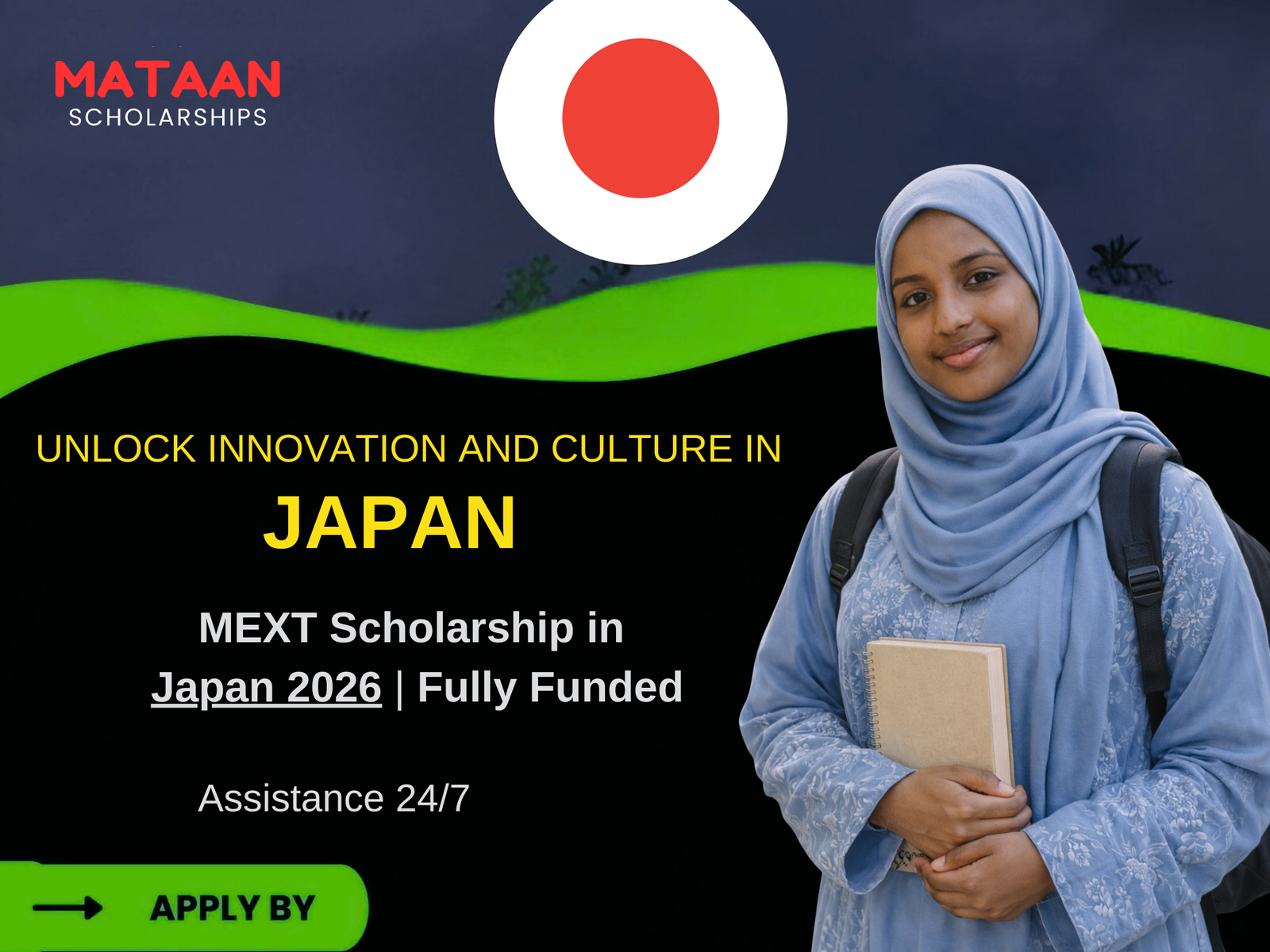
MEXT Scholarship in Japan 2026 | Fully Funded
The MEXT Scholarship, officially known as the Japanese Government (Monbukagakusho) Scholarship, is a fully funded international scholarship offered by the Ministry of Education, Culture, Sports, Science and Technology (MEXT) of Japan. The scholarship is designed to foster international human resource development and promote mutual understanding between Japan and other countries by supporting outstanding international students to study in Japan.
For the 2026 intake, the MEXT Scholarship supports international students at Bachelor’s, Master’s, PhD, diploma, and research levels at Japanese national, public, and selected private universities. All major academic fields are covered, and both English-taught and Japanese-taught programs are available.
Levels of Study Covered (2026)
The MEXT Scholarship provides funding for multiple categories. The Research Student category is the most popular and allows applicants to pursue Master’s or PhD degrees after an initial research period. Undergraduate scholarships support full Bachelor’s degrees, while specialized categories exist for College of Technology, Specialized Training Colleges, and Teacher Training programs.
Most graduate programs begin with a research or non-degree period before formal degree enrollment. Students without sufficient Japanese language proficiency may first complete a one-year Japanese language preparatory program, which is fully funded by MEXT.
What the Scholarship Covers (Fully Funded Benefits)
The MEXT Scholarship for 2026 is fully funded and covers all essential academic and living costs. Tuition fees are completely waived for the entire duration of study. A monthly stipend is provided to cover living expenses, accommodation, food, and transportation.
For 2026, the standard monthly allowance is approximately ¥117,000–¥120,000 for undergraduate students, ¥143,000–¥145,000 for Master’s students, and ¥145,000–¥148,000 for PhD students, with possible additional regional allowances for students studying in designated areas. The scholarship also includes round-trip international airfare between the student’s home country and Japan, as well as full national health insurance coverage under Japan’s system.
Eligibility Criteria for 2026 Applicants
Applicants must be non-Japanese citizens with good physical and mental health. Undergraduate applicants must have completed high school and generally be between 17 and 25 years old by April 2026. Master’s applicants must hold a Bachelor’s degree and typically be under 35 years old, while PhD applicants must hold a Master’s degree and also usually be under 35 years old.
Applicants must demonstrate strong academic performance and meet the admission requirements of Japanese universities. Japanese language ability is not mandatory at the time of application for many programs, especially those taught in English. However, applicants must be willing to learn Japanese and adapt to academic life in Japan.
Types of MEXT Scholarship Application Routes
There are two main application routes. The Embassy Recommendation route is the most common and competitive pathway, where applicants apply through the Japanese Embassy or Consulate in their home country. The University Recommendation route allows applicants to be nominated directly by a Japanese university for selected programs.
For the 2026 intake, most applicants are advised to apply through the Embassy Recommendation route, as it offers broader access to universities and fields of study.
Application Timeline for 2026 Intake
The Embassy Recommendation application process for MEXT 2026 typically begins between April and May 2026. Written examinations and interviews are conducted between May and July 2026. University placement and final screening by MEXT take place from September to December 2026, with final results usually announced by January or February 2027. Successful candidates begin their studies in Japan in April or September 2027, depending on the program and university.
Exact dates vary by country, as each Japanese embassy sets its own schedule within the official MEXT framework.
How to Apply (Step-by-Step for 2026)
Applicants must first apply through the Japanese Embassy or Consulate in their home country under the Embassy Recommendation scheme. The application includes submission of academic transcripts, degree certificates, a detailed study or research plan, recommendation letters, medical examination form, and proof of nationality.
Shortlisted applicants sit for written examinations (usually English and Japanese, depending on the level and field) and attend an interview conducted by the embassy. Candidates who pass are then nominated to MEXT and proceed to seek acceptance or placement at Japanese universities with MEXT’s assistance.
University Recommendation applicants follow procedures set by the individual Japanese universities and apply directly to the institution.
Fields of Study Available
The MEXT Scholarship covers nearly all academic disciplines, including engineering, information technology, artificial intelligence, medicine, public health, economics, international relations, education, agriculture, environmental science, social sciences, and humanities. Japan places strong emphasis on science, technology, and innovation, but social and development-oriented studies are also well supported.
Official Information and Application Links
MEXT Scholarship official information (Study in Japan):
https://www.studyinjapan.go.jp/en/smap-stopj-applications-scholarships-mext.html
Japanese Government MEXT page:
https://www.mext.go.jp/en/
Japan Student Services Organization (JASSO):
https://www.jasso.go.jp/en/
List of Japanese universities:
https://www.studyinjapan.go.jp/en/planning/search-school/
Selection Criteria
Selection is based on academic excellence, quality and feasibility of the study or research plan, performance in written exams and interviews, recommendation letters, and overall potential to contribute to long-term cooperation between Japan and the applicant’s home country. Motivation, clarity of goals, and adaptability to Japanese academic life are critical factors.
Important Advice for 2026 Applicants
Applicants should begin preparation early in 2026, focusing on a clear and realistic study plan aligned with Japan’s academic strengths. Strong academic records and well-structured motivation statements significantly improve success chances. Embassy deadlines are strict, and incomplete applications are not considered.
Recent Posts

Top 20 GOI-IES 2026 Eligible Irish Universities for…
 February 9, 2026

500 Master’s Degrees Programs at UK Universities:
February 2, 2026

List of 300 Bachelor’s Programs at UK Universities:
February 2, 2026
List of Master’s Degree Programs in English at…
February 2, 2026
Bachelor’s Degree Programs in English at Italian Universities…
February 2, 2026